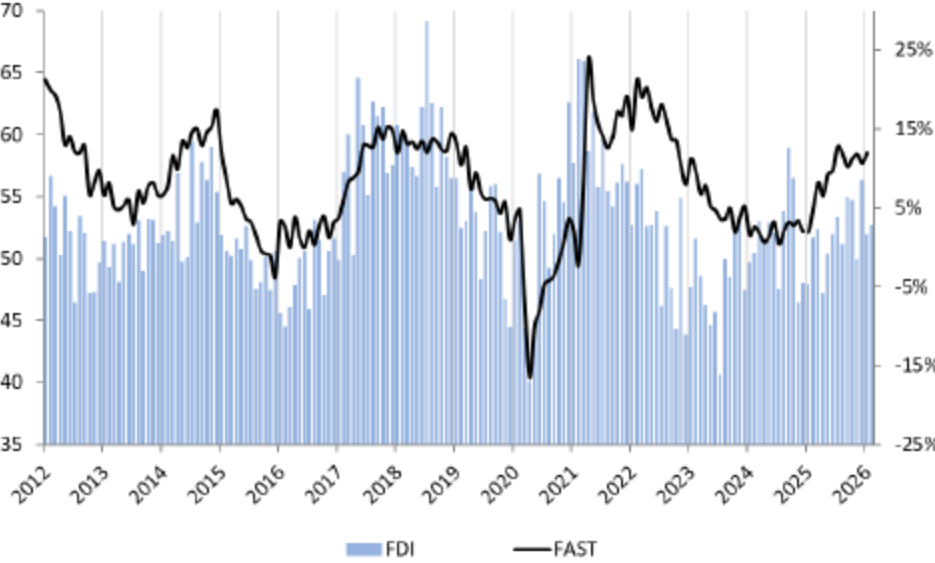
The Fastener Distributor Index (FDI) modestly improved in February to 52.7, reflecting growth in sales and customer inventories while supplier deliveries declined.
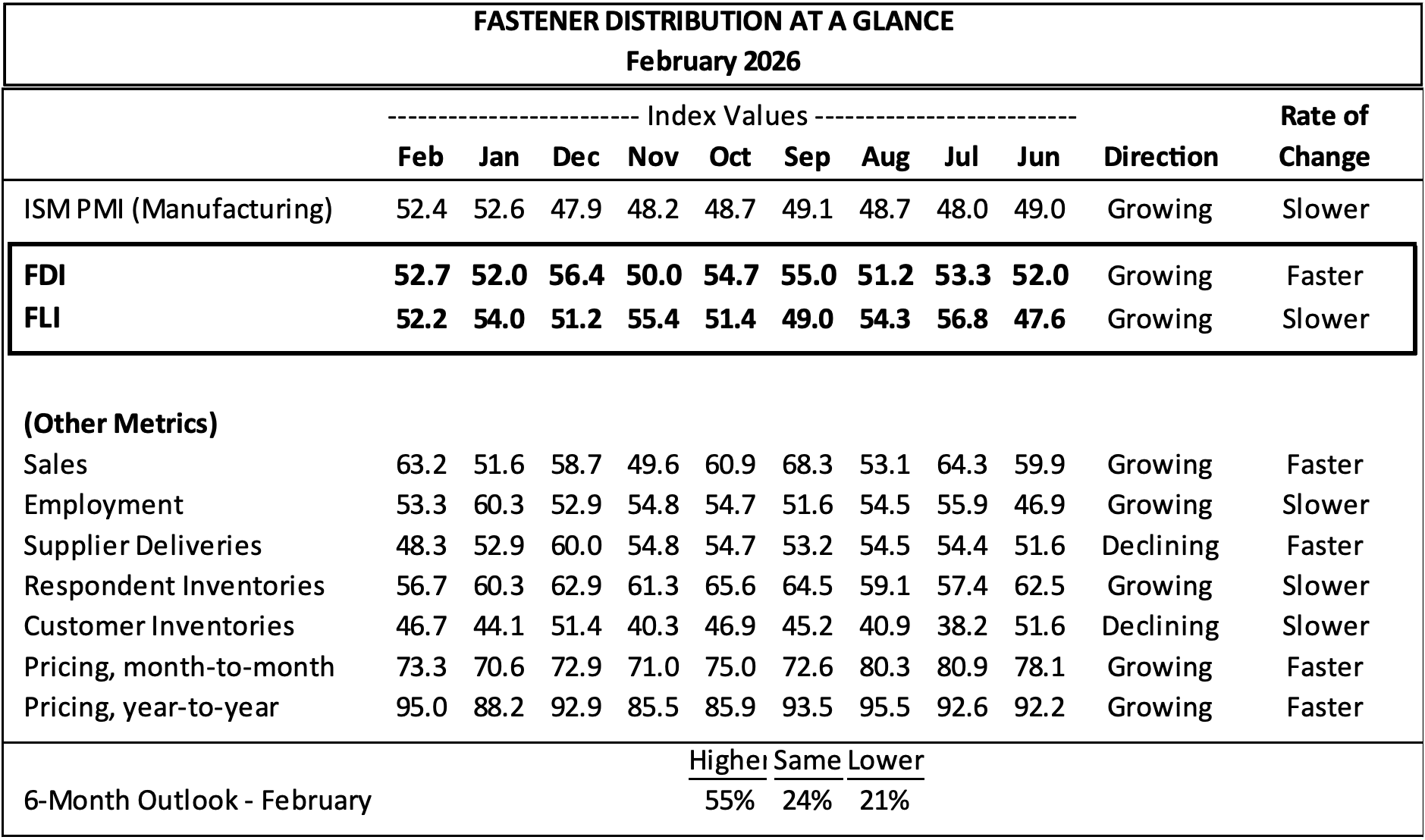
The sales index jumped to 63.2 from 51.6 in January. Half of respondents indicated sales came in above seasonal expectations, which is higher than the 43% average registered over the past year. An additional 27% indicated sales disappointed (vs. 24% last month).
Customer inventories contributes to the expansion, as the share of participants saying “lower than seasonal norms” decreased (from 21% to 20%), while a strong majority (67%) continue indicate customer inventories are in line.
Employment moderated in February, dropping to 53.3 from 60.3 the previous month. A majority of respondents (53%) reported stable pricing. Year-to-year pricing hiked to 95 compared to 88.2 in January.
The Forward-Looking Indicator slipped to 52.2 from 54 in January, driven by lower employment levels and customer inventories (13% “too high”).
“Looking specifically at the six-month outlook, the moderation appears driven more by a shift in distribution than a broad-based pullback in expectations,” wrote R.W. Baird analyst David J. Manthey, CFA, with Inara Khan, CFA. The share of respondents anticipating stable activity declined to 24% (vs. 35% in January).
“Fewer respondents are sitting in the ‘steady’ camp, with incremental movement toward both improved and weaker expectations.”
Commentary suggests continued momentum, though regional softness and ongoing tariff-related uncertainty continue to weigh on sentiment.
“February was a good month,” one respondent noted. “Our inventory is up but our in-coming order rate was 17% higher than January.”
Even adjusting for the shorter month, demand appeared stable in some regions.
“Not hearing much from customers so far other than expect the year to be similar to 2025.” Underlying demand sentiment remained constructive.
“Regardless of what I read in the papers or hear on the radio, demand for fasteners in the U.S. is very strong for our business,” one participant noted. “Going to continue to ride it out as long as we can.”
Not all regions saw growth, however.
“Things are rapidly slowing down here in the south. Our vendors are complaining, our customers are complaining, and now we’re complaining. The housing market, which was red hot here in Florida, is grinding to a halt and turning into a buyer’s market again for the first time in awhile.”
Tariffs remain a dominant theme.
“Latest tariff issues are frustrating,” one respondent noted. “Need to focus on growth and customer relationships, not tariff roller coaster.”
Another noted: “Ongoing uncertainty with tariff calculations. Add to that the thought of applying for refunds now that IEEPA has been deemed illegal.”
Policy volatility continues to weigh on sentiment.
“The first batch of tariffs, which SCOTUS wisely struck down, have been replaced with new, equally illegal tariffs. Uncertainty is ALWAYS BAD for business – that’s a bi-partisan statement right there.”
Operationally, sourcing pressures linger, particularly in stainless and automotive.
“We have a heavy mix of stainless products and prices are trending higher. Automotive pressure to move from Taiwan to US is a difficult task and a waste of resources in most cases.”
The FDI is a monthly survey of North American fastener distributors conducted by the FCH Sourcing Network, the National Fastener Distributors Association and Baird.