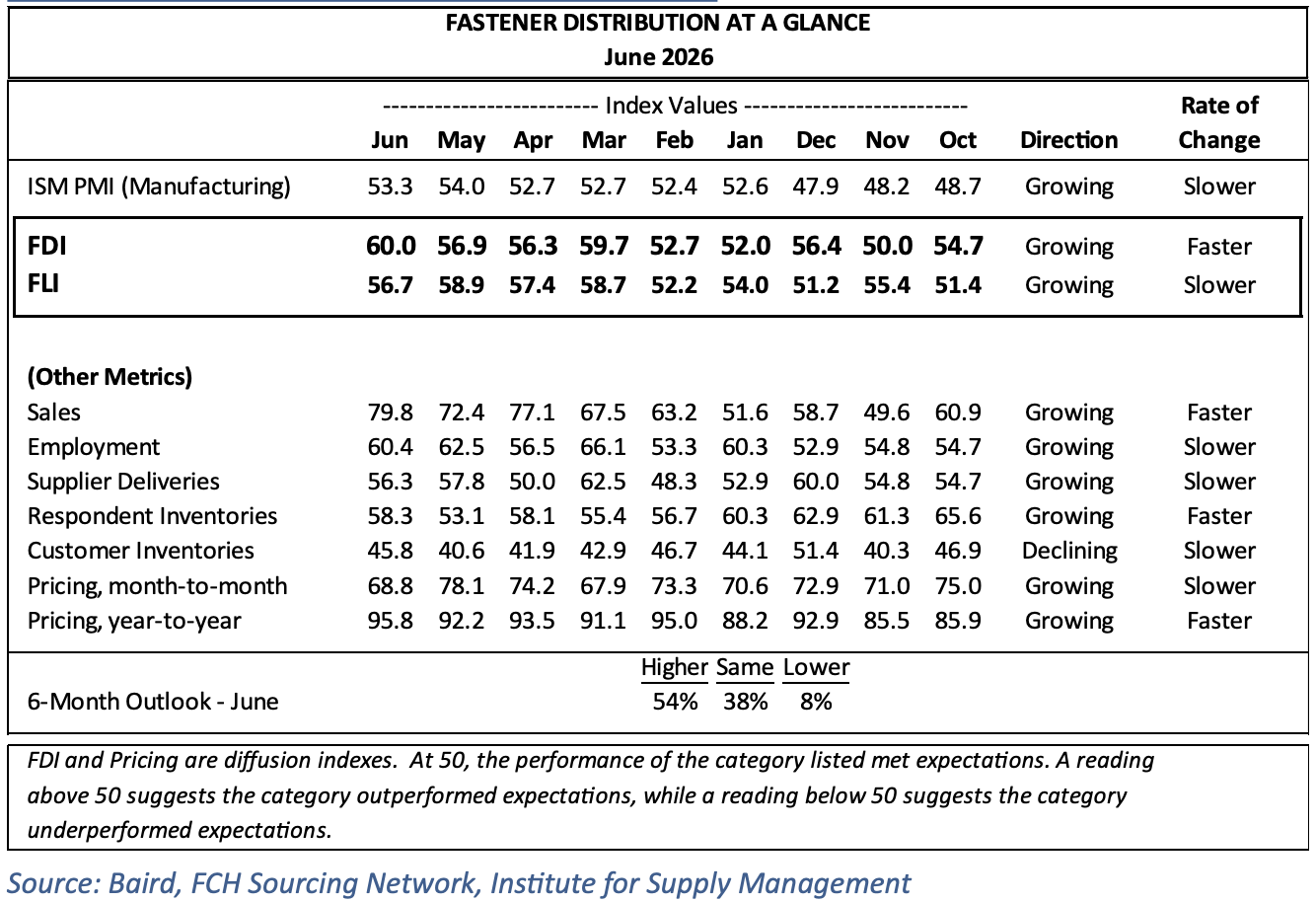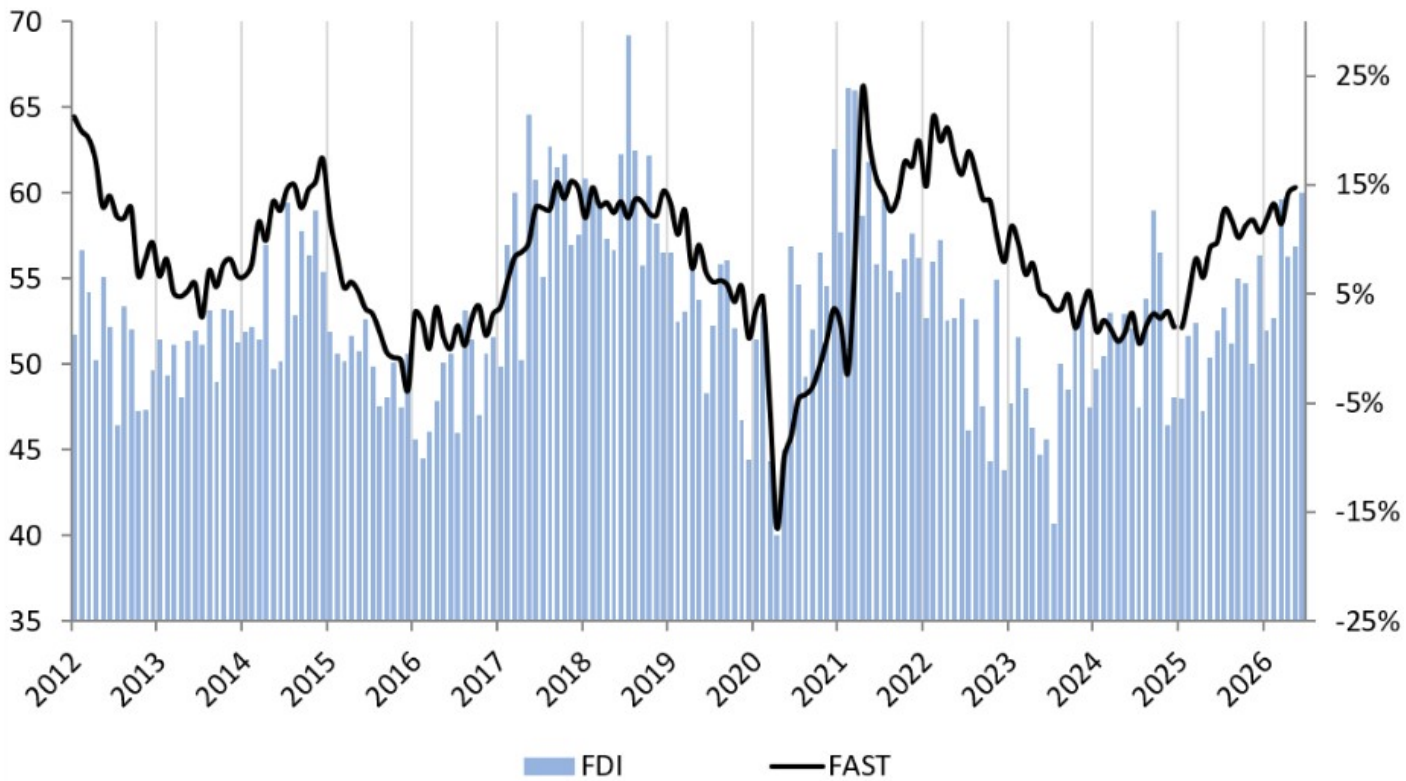
The seasonally adjusted Fastener Distributor Index (FDI) jumped to 60 in June – the strongest reading since mid-2021 and the 14th consecutive month in expansionary territory. The leap was led by a sharp acceleration in sales and an improvement in customer inventory levels, which more than offset modest m/m easing in employment and supplier deliveries.
The sales index accelerated to 79.8 (from 72.4 in May), with 63% of respondents indicating sales came in above seasonal expectations – up from 59% last month and well ahead of the ~51% average over the past year – with 33% reporting in-line sales (up from 28% in May) and just 4% indicating below (vs. 13% last month). Customer inventory levels again acted as a drag on the index (sixth consecutive sub-50 reading, at 45.8) but improved sharply from 40.6 in May as the share of respondents saying “lower than seasonal norms” fell to 21% (from 25%), while the “too high” share rose to 12% (from 6%, signaling some restocking), and the overwhelming majority (67%) continue to say customer inventories are in line.
The employment index eased to 60.4 (from 62.5); the percentage noting levels “higher than seasonal norms” held at 29% (vs. 28%), though “in line” slipped to 63% (from 69%) and 8% noted lower levels (vs. 3%). Supplier deliveries also slipped to 56.3 (from 57.8), as 21% of participants reported slower lead times/deliveries (down from 25%), with the majority (71%) indicating similar levels.
On pricing, 38% of respondents saw higher m/m pricing (down from 56% in May and 48% in April) while the remaining 62% reported stable m/m pricing; notably, 0% saw lower m/m pricing for a fifth consecutive month – in other words, pricing has either increased or held steady m/m for five straight months. Year-over-year pricing, however, accelerated, increasing for 92% of participants and remained stable y/y for 8% (vs. 84% and 16% in May, respectively).
The Forward-Looking Indicator (FLI) declined to 56.7 in June (from 58.9 in May), signaling a more measured forward view. The slight m/m moderation was driven by a rebuild in customer inventories (45.8 vs. 40.6 in May), with a slight easing in employment, only partially offset by a firmer six-month outlook. Expectations improved modestly – 54% of respondents now anticipate higher six-month activity levels vs. today (up slightly from 53% last month), while only 8% expect lower levels (down from 13%) and 38% foresee similar levels (up from 34%).
Despite the sequential dip in the FLI, the divergence appears driven more by inventory normalization than by any deterioration in demand expectations, and overall sentiment continues to lean constructive on the 2026 outlook.
Commentary suggests demand remained generally healthy through quarter-end, supported by new business wins and continued data center activity, even as cost pressures and demand-visibility concerns drew more attention. Several respondents continued to report solid performance.
“June was a record booking month and a very strong shipping period. Only bad news was hearing of some mid-year price increases due in July,” one respondent stated.
Even so, not all participants were convinced current demand can be sustained.
“Hard to believe our economy can hold the current pace.”
Cost and supply-chain challenges remain key themes.
“Resourcing to domestic or non-class D countries still presenting a minor challenge dependent on certain items that are just not mass produced in the US.”
“Pricing continues to be negatively impacted by skyrocketing freight charges. And we’re back to being unable to find good workers.”
End-market conditions also appear increasingly mixed beneath the surface. “Usage continues to remain flat, with sales tracking near inflationary growth rates,” one participant observed. “Data center activity remains strong across indirect verticals; however, we are seeing softness in other markets as a result of oil price pressures. Bookings continue to trend below expectations.”
June commentary suggests underlying demand remains constructive, supported by record bookings, ongoing new business wins, and continued strength tied to data centers.
However, rising freight costs, labor availability, domestic sourcing challenges, and softer bookings outside of key growth markets echo the cooler forward signal in this month’s FLI and suggests operating conditions remain uneven heading into the second half of 2026.
Fastenal reported May daily sales growth of +14.8% y/y, ahead of both our +13.7% estimate and FAST’s +13.1% benchmark. Coming off a strong April (+14.3%), ADS growth accelerated a further ~50bps m/m and was +170bps better than what normal seasonality/benchmark growth would have implied, with the acceleration broad-based. Direct materials (production-related; 39% of sales) grew +16% (April +16.2%) and indirect materials (MRO-related; 61% of sales) accelerated to +14.5% (vs. +13.7% last month).
Specifically, direct fasteners/hardware sales (~21% of overall May sales) grew +15.9% y/y (vs. +18.4% prior month) and indirect fasteners/hardware sales (~10% of sales) increased +15.3% (vs. +19.0% in April)
The FDI is a monthly survey of North American fastener distributors conducted by the FCH Sourcing Network, the National Fastener Distributors Association and Baird.