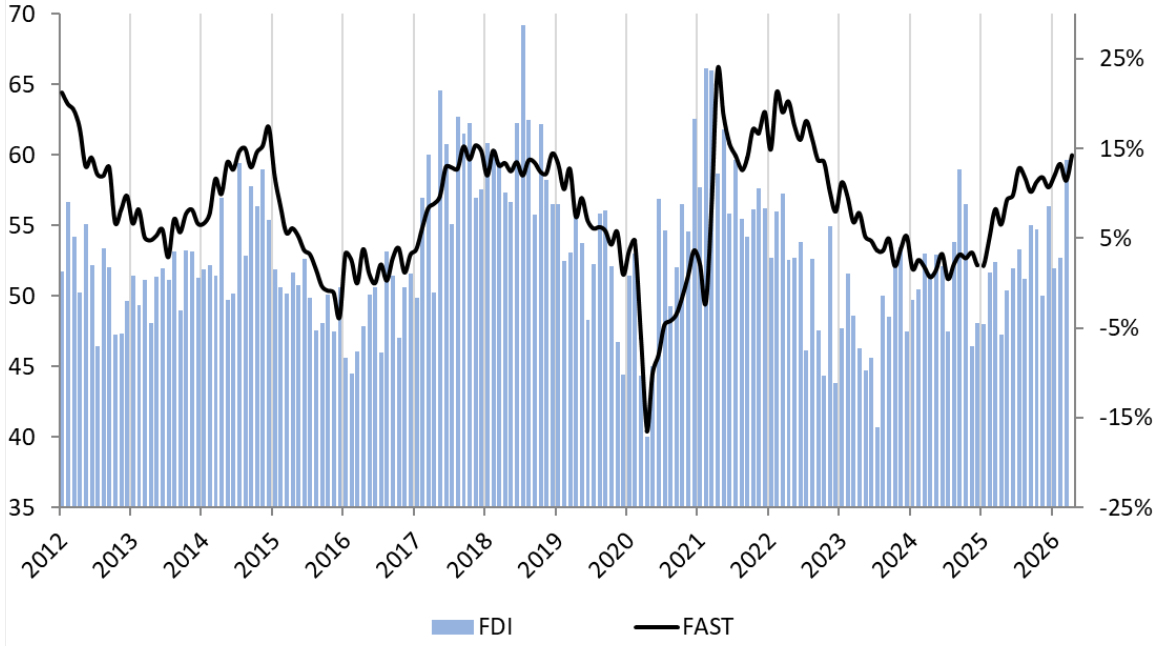
The Fastener Distributor Index showed continued growth in April, although at a slower pace than March. This month, the index slightly moderated m/m to 56.3 from March’s 59.7, indicating continued, but slower expansion. Despite three of the four underlying factors (employment, customer inventory, and supplier delivery levels) seeing m/m contraction, April’s FDI reading still marks the second-highest monthly FDI reading in 2026 thus far and second consecutive 55+ reading.
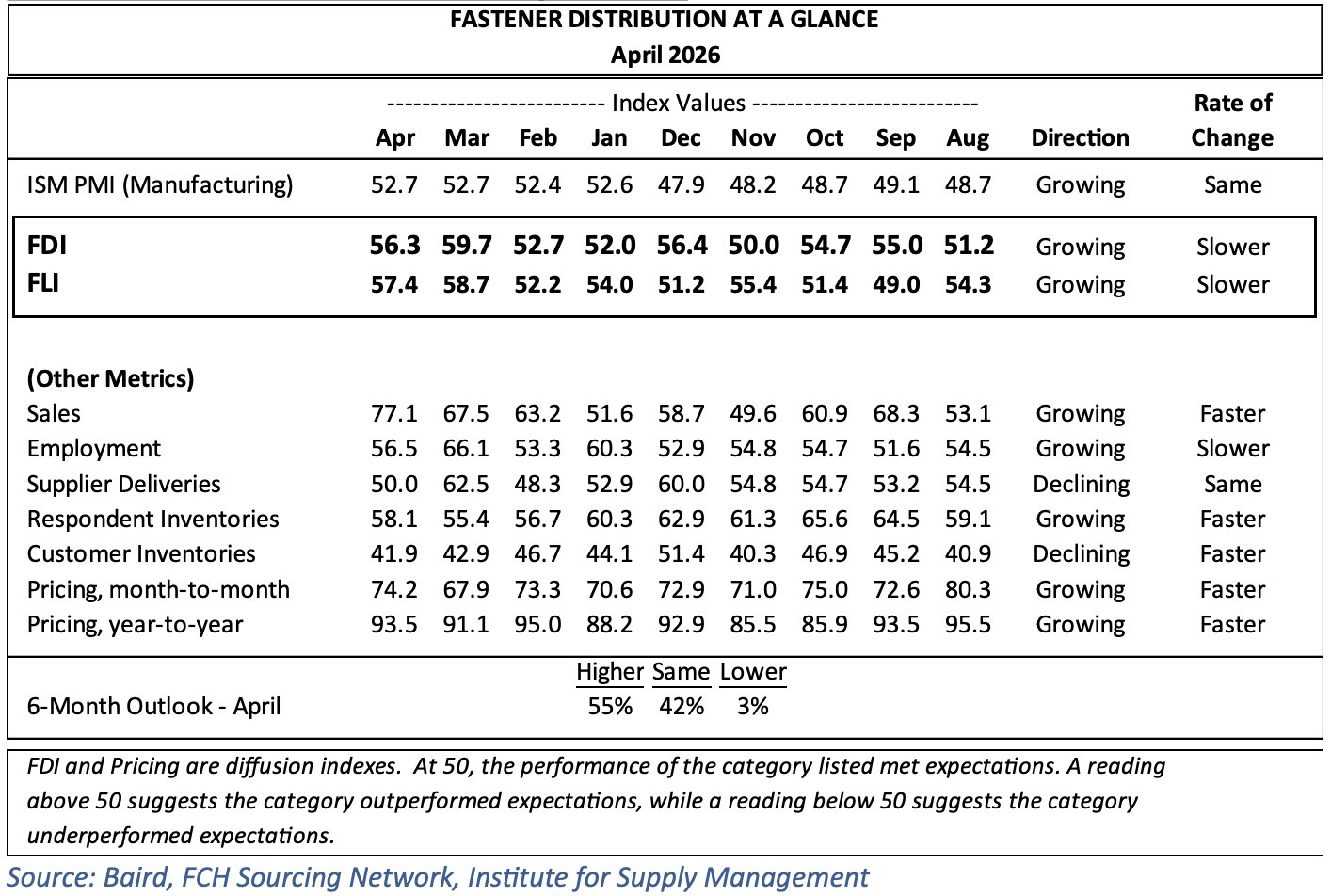
Notably, the seasonally adjusted sales index reached 77.1 in April, up from a strong 67.5 March reading and signaling improving demand momentum. Demonstrating the improvement in underlying demand conditions, 68% of respondents indicated sales came in above seasonal expectations, which is higher than the 47% average registered over the past year. Year-over-year pricing increased for 87% of participants, and pricing remained stable y/y for 13% of respondents (vs. 86% and 11% in March, respectively). Meanwhile, on a monthly basis, a little more than half of respondents this month (52%) said pricing was stable m/m (vs. 64% in March); the remaining 48% of respondents in April saw higher sequential pricing (0% saw lower m/m pricing, for a third consecutive month – in other words, pricing has either improved or remained stable m/m for three consecutive months).
Consistent with the US jobs report in April (payroll growth decelerated sharply from an unusually strong March), employment levels moderated a bit, with the 56.5 FDI employment index a step down from last month’s 66.1 reading; the share of participants noting levels “higher than seasonal norms” decreased to 16% from 36% (overwhelming majority – 81% – still report employment is in line). Customer inventory levels again acted as a drag on the index (fourth consecutive sub-50 reading), though the overwhelming majority (71%) continue to say customer inventories are in line, and only 6% of respondents said customer inventories were “too high” (compared to 11% last month). Lastly, 13% of participants reported slower supplier lead times/deliveries this month (down from 29% in March), though the majority (74%) continue to indicate similar levels.
The Forward-Looking Indicator (FLI) declined slightly to 57.4 in April (from 58.7 in March), suggesting just a touch less optimistic forward view for respondents, although still points to solid near-term momentum. Factors driving this moderation included lower employment levels and faster supplier deliveries, not a more measured six-month outlook. In fact, a slightly greater percentage of respondents are now anticipating higher six-month activity levels vs. today than were last month (April 55% vs. March 54%), while only 3% of the survey anticipate lower levels (down from 18%/21% in March/February). A larger percentage of participants also foresee similar levels (42% in April vs. 29% last month), consistent with the ISM PMI remaining expansionary for a fourth consecutive month (April 52.7; March 52.7; February 52.4; January 52.6). Coupled with this continued momentum in the broader industrial economy, we believe that, although some caution persists due to ongoing macroeconomic/inflation/tariff uncertainties, overall sentiment among participants continues to lean cautiously optimistic on the 2026 outlook overall.
April commentary suggested continued solid momentum following a strong 1Q, though visibility appears incrementally more mixed beneath the surface. Several respondents pointed to sustained strength in April.
“All customer sectors of ours show strong growth with bookings, and more customers than not are still accepting their orders early,” one participant noted. “Positive signs for our business, overall.”
Strength was echoed elsewhere.
“In spite of the media reported headwinds, the customer build rates and volumes have remained remarkably consistent.”
While revenue momentum remains intact, some signs of moderation in activity were flagged.
“We’ve had a really good month of sales but quoting activity did slow down toward the last half of the month,” one respondent noted.
Even so, expansion efforts continue, as one participant shared, “We are continuing to roll out new business throughout the remainder of 2026.”
End-market trends remain constructive but uneven.
“Certain end user markets stronger, trailer, heavy truck, general industrial while auto is flat,” consistent with prior months’ divergence,” one respondent observed.
One respondent highlighted the administrative burden tied to trade policy.
“$300 in documents for a $50 box of bolts, this is why prices are going up.”
Another noted: “YEAR OVER YEAR COST IMPACTED MAINLY BY TARIFF (ORGANIC COST INCREASE 5%).”
Policy shifts continue to create friction, as “Recent policy changes driven by GM and others for USA melt and production are troublesome.” Meanwhile, one participant cautioned, “Concern(ed) how gas prices will affect future sales.”
April reflects another solid month of revenue performance for many participants, supported by resilient end markets and continued new business rollout, though quoting trends, cost pressures, and mixed customer sentiment suggest visibility remain uneven.
The FDI is a monthly survey of North American fastener distributors conducted by the FCH Sourcing Network, the National Fastener Distributors Association and Baird.