China’s fastener exports continued to grow in 2025.
The total export value of Chinese fasteners for the year reached approximately US$11.92 billion, representing a year-on-year increase of 4.1%, according to preliminary customs statistics. Export volume totaled around 6.24 million tons, up 6.7% year-on-year, while the average export price was approximately US$1,910 per ton, slightly decreasing 2.4% compared to 2024.
China’s fastener industry is moving into a phase of “higher volume, stable pricing, and structural upgrading.” Export volumes are expanding, while prices remain under pressure from global competition, new capacities in emerging markets, and volatility in inflation and raw material costs.
“Looking at the full year of 2025, the export market is transitioning from being ‘dominated by Europe and the U.S.’ to a multi-region growth model, with Asia and emerging markets serving as new growth poles,” stated Herry Meng, GM of Fastener Expo Shanghai. “Enterprises need to accelerate market diversification and adopt localized service strategies.”
Changes in Export Market Structure
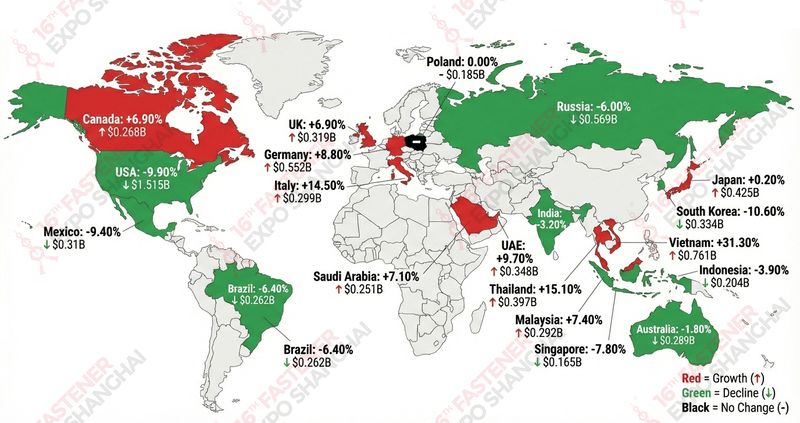
In 2025, China’s top 30 fastener export destinations totaled US$9.34 billion, accounting for 78.3% of exports—down slightly from 79.6% in 2024, signaling a more diversified market structure.
European Market
China’s fastener exports to major European economies continued to grow. Export values to Germany, the UK, and Italy increased 8.8%, 6.9%, and 14.5% year-on-year, respectively, while exports to the Netherlands also rose 14.9%. This growth reflects Europe’s sustained demand for Chinese fasteners across various applications, including automotive manufacturing, machinery, construction, and infrastructure.
The total imports by Western European countries reached US$2.06 billion, surpassing the U.S. and becoming China’s largest export destination. Europe’s growing demand also calls for diversified global fastener supply chain collaboration.
U.S. Market
The U.S. remains China’s largest single fastener export market. In 2025, exports totaled about US$1.52 billion, down nearly 10% in value and 9.7% in volume, mainly due to U.S. trade policies, tariffs, and supply chain adjustments.
Southeast Asia
Vietnam became China’s second-largest export destination, with exports rising 30% to US$761 million. The growth is mainly driven by its role as a regional transshipment hub rather than purely by end-market demand. Exports to other ASEAN countries such as Thailand and Malaysia also increased in 2025.
Russian Market
Russia remained the third-largest market, with exports dropping 6% to US$569 million. High-end fasteners still retain premium pricing.
Japanese, South Korean, and Indian Markets
Japan’s exports edged up 0.2%, South Korea’s declined 10.6%, and India’s dependence on Chinese standard fasteners decreased due to domestic industry growth and local sourcing policies.
ASEAN, Central Asia, and Belt & Road Markets
ASEAN remains a major growth engine for China’s fastener exports, with Thailand (up 15.1%) and Malaysia (up7.4%) continuing to expand. Central Asia, led by Kyrgyzstan (up 89.7%) and Kazakhstan (up 51.1%), saw rapid growth driven by rising demand for Chinese industrial products. Middle Eastern markets such as the UAE (up 9.7%) and Saudi Arabia (up 7.1%) also sustained momentum, supported by infrastructure and industrial projects and their role as transshipment hubs to Europe and the U.S.
Export Performance by Product Category
China’s fastener exports in 2025 continued shifting toward higher value-added and specialized solutions.
High-strength fasteners (“Other Screws and Bolts, ≥800 MPa”) grew 11%, and copper fasteners rose 14.7%, with prices up 14.1%, reflecting premium potential from special materials and system integration.
Bulk standard fasteners grew in volume but saw falling prices. “Steel Nails and Flat-Head Nails” rose 4.6% in volume but dropped 5.6% in price, while traditional items like “Self-Tapping Screws” and “Nuts” showed similar trends, reflecting intense competition and margin pressure.
The fastener industry is upgrading from “ordinary standard fasteners” to “high-strength, corrosion-resistant, lightweight, and customized” solutions, but transformation speed is uneven: high-end segments are growing strongly, while traditional categories remain scale-dependent and vulnerable to raw material prices and international competition.
Changes in Provincial Export Patterns
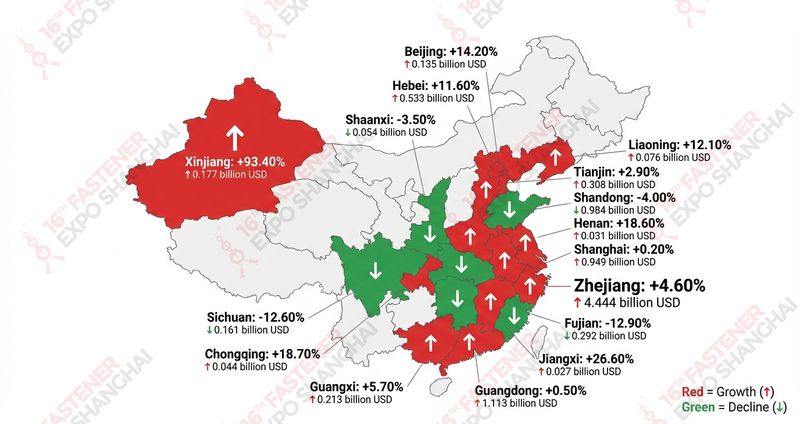
Against a backdrop of stable overall growth, China’s provincial export patterns show structural evolution.
Traditional hubs in the Yangtze and Pearl River Deltas have shifted to a quality-driven stage:
- Zhejiang’s exports grew 4.6%, accounting for nearly 40% of national exports, driven by industry chain support and optimized product structure;
- Jiangsu’s exports rose 6% with higher unit prices;
- central and western provinces leveraged cost, location, and policy advantages: Hebei’s exports increased 11.6% in value and 23.4% in volume, focused on standard and bulk fasteners;
- and Xinjiang surged 93.4%, benefiting from its role as a Belt & Road western corridor hub and the China-Europe Railway Express.
While traditional coastal bases consolidate advantages, central, western, and border provinces are leveraging policy and location for rapid growth, Meng noted. China’s fastener exports are shifting from coastal-led to multi-region coordinated development, with industrial clusters.