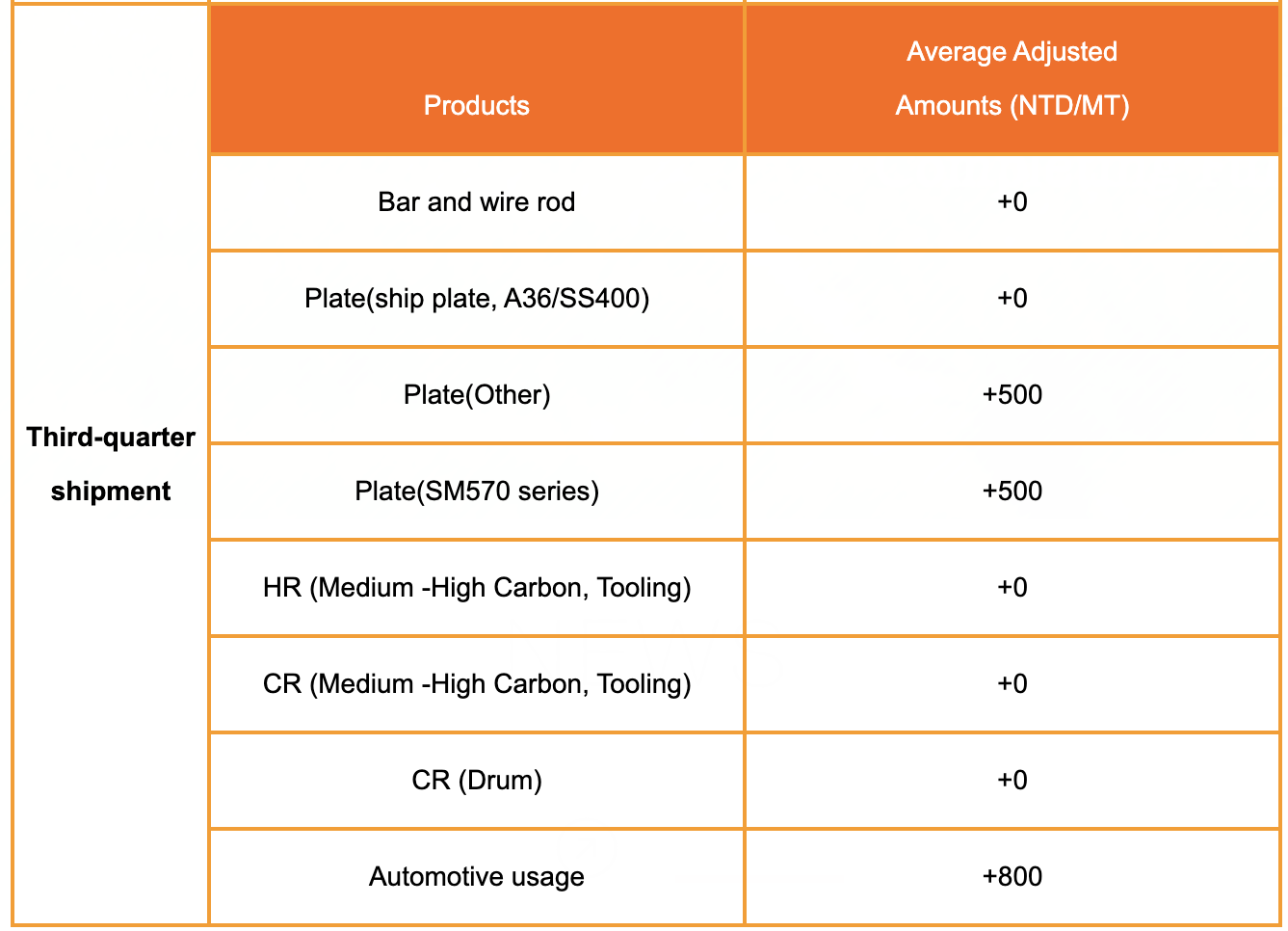
Taiwan’s China Steel Corp. announced that third quarter prices for bar steel & wire rod (low carbon, medium-high carbon, cold-forged, low alloy) will remain flat.
“The global economy is showing a moderate recovery, but faces challenges from the off-season demand in the third quarter and changes in global trade conditions,” the steel manufacturer stated.
These include the U.S. raising Section 301 tariffs on China, new EU steel safeguard measures, and adjustments to the ECFA between Taiwan and China.
CSC chose to “maintain a flat-to-high price trend to stabilize customers' procurement costs and assist users in securing orders.”
Major economies such as the U.S., Europe, and China are seeing increased momentum in manufacturing recovery. S&P Global reported that the US PMI for May was 51.3, remaining in expansion territory for five consecutive months. The Eurozone's May PMI index rose from 45.7 in April to 47.3, indicating an acceleration in manufacturing momentum. In China, the national bank lowered interest rates to boost market confidence.
Taiwan benefits from the revival of demand, as indicated by its PMI rebounding from 49.4 in April to 55.4 in May.
“The high-tech and semiconductor boom has driven strong demand for factories and commercial buildings, leading to a bustling steel structure and construction steel industry,” CSC stated.
However, CSC increased prices for automotive materials by NT$800 per metric ton in Q3.
With global car sales recovering, Taiwan’s domestic car sales topped 191,000 units in the first five months of 2024, moderately lower than last year’s 192,000 units.
According to worldsteel statistics, global steel demand peaked at 1.845 billion tons in 2021 but experienced a decline due to factors such as wars, high inflation, high-interest rates, high inventory, and geopolitical risks, reaching a relative low of 1.763 billion tons in 2023. Demand is expected to grow by 1.7% and 1.2% in 2024 and 2025, respectively, returning to 1.815 billion tons — an increase of 52 million tons over two years.
“Looking ahead to the second half of 2024, the end-use demand for the steel industry is expected to rebound and return to its growth trajectory with the support of global monetary easing and economic stimulus policies.” Web: csc.com.tw/indexe.html