An emergency landing of a new Boeing 737-MAX-9 aircraft in Portland, OR, on January 5 after an exit panel blew off at 16,000 feet — imperiling 171 passengers and 6 crew members — rekindled questions about the fuselage assembly on the fourth-generation of Boeing’s bestselling aircraft.
Passenger videos showed a gaping hole beside a row of seats. Some on board described pieces of debris flying around and frigid air rushing in as the pilots made an emergency landing. No serious injures were reported.
The Boeing 737 Max 9 has an emergency exit door cut behind the wings for use in dense seating cabin configurations, like those used by budget airlines, but the doors are plugged to prevent usage.
[caption id="attachment_83677" align="alignright" width="400"]
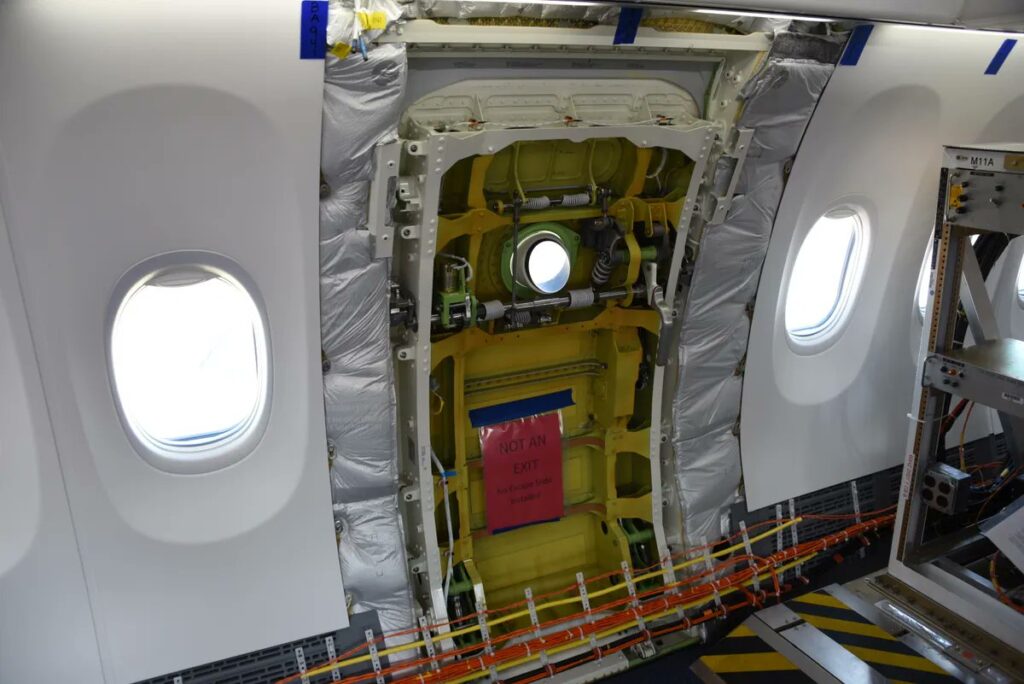
Plug Boeing fits over a door opening on the MAX 9[/caption]
The harrowing January 5 ordeal was described as “an explosive decompression at the window exit,” according to Sara Nelson, president of the Association of Flight Attendants-CWA, the labor union that represents Alaska’s cabin crew and flight attendants.
Most troubling, the aircraft was delivered in October 2023 and had only logged 145 flights — practically brand new by aviation standards.
In response, the Federal Aviation Administration on Saturday grounded more than 170 Boeing 737 Max 9 aircraft for inspections. Each inspection will take up to 8 hours per aircraft.
"This has all the earmarks of a manufacturing deficiency, a quality escape from Boeing,” a former FAA accident investigation chief told Bloomberg.
While the technical issue that led to the scare appeared unique, Boeing’s 737 Max airliners have perhaps the most worrisome history of any modern jetliner currently in service, according to NYT.com.
The Boeing 737 Max 9 is a larger version of the best-selling 737 Max 8, which were grounded worldwide in 2019 after two fatal crashes within six months. The U.S. approved the jets' return to service in late 2020 after software and training updates.
In August 2023, Boeing found fastener holes on some 737s in the aft pressure bulkhead — the heavy metal dome capping the back end of the passenger cabin that is essential to maintaining cabin pressure — had been improperly drilled by fuselage manufacturer Spirit Aerosystems. Called “snowmen,” due to their elongated shape of two overlapping holes of differing size, these holes were filled with fasteners and passed quality inspections at Spirit before being shipped by rail to Boeing, according to Jon Ostrower for The Air Current.
As recently as December 29, Boeing asked airlines to inspect its 737 Max jets for a potential loose bolt in the rudder control system after an international operator found a bolt with a missing nut during routine maintenance. In a separate case, Boeing also discovered an undelivered aircraft with a nut that was not properly tightened.
Large-scale groundings of aircraft by the FAA are rare.