U.S. President Donald Trump signed an aggressive “reciprocal” tariff policy on April 2.
Setting a 10% baseline tariff on all imports, the plan imposes steep tariff rates on many countries, including:
- 34% on China (+ 20% = 54%);
- 32% on Taiwan;
- 46% on Vietnam;
- 25% on South Korea;
- 24% on Japan;
- 20% on the EU;
- 10% on the UK.
The tariff rate on Beijing comes in addition to existing 20% tariffs on Chinese imports, meaning the true tariff rate on China is 54%.
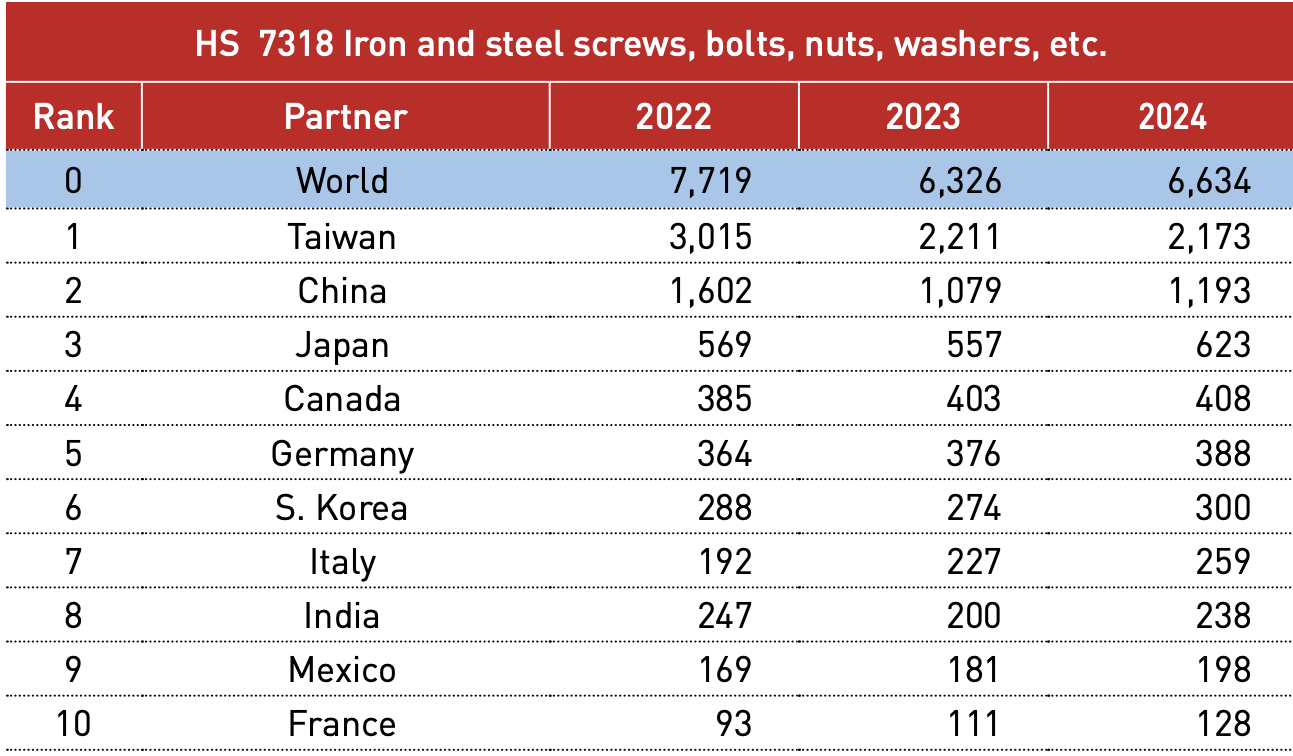
Nearly 33% of U.S. fastener imports worth $2.17 billion came from Taiwan in 2024, according to the Department of Commerce. Chinese fasteners comprised 18% of total U.S. fastener imports valued at $1.2 billion. Fastener imports from Japan totaled $623 million during 2024, while fastener imports from South Korea totaled $300 million.
Trump’s “reciprocal” tariffs are on top of the previous 25% duties he placed on imports from Canada and Mexico. He imposed and later amended the tariffs to exclude automobiles and goods covered under a free trade agreement he negotiated with the countries during his first term. Trump also put a 10% tariff on Canadian energy imports.
Within 24 hours, the S&P 500 fell almost 5%, its worst drop since June 2020. Likewise, the FIN Fastener Stock Index dropped 4%.
It will cost an additional $714 billion to bring shoes, TVs and all other imports into the U.S., according to a new Trade Partnership Worldwide analysis of Census Bureau trade data.
If the new rates were applied to everything the U.S. imported last year, the combined cost in tariffs to bring in all of those goods would be roughly 10 times what companies paid in 2024, according to a calculation from Trade Partnership Worldwide.
“These are staggering high tariffs that will have a major impact on costs for a wide range of products,” said Dan Anthony, president of Trade Partnership Worldwide.