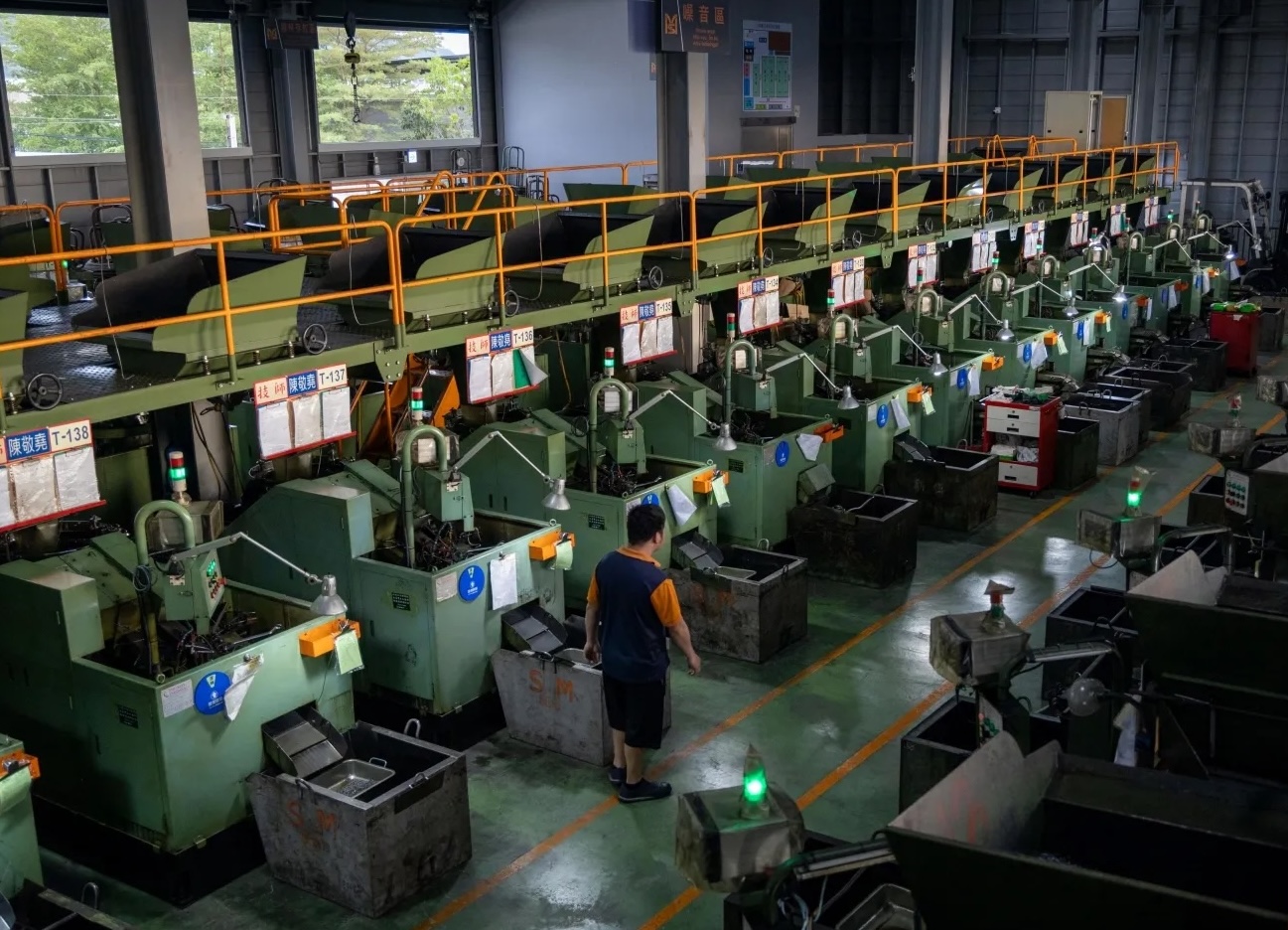
U.S. President Donald Trump’s punitive tariffs have created a tsunami of chaos in Taiwan’s fastener industry, Commonwealth Magazine reports.
Unlike other industries on the island nation, which have yet to actually feel the full brunt of Trump’s tariffs, Taiwan’s fastener sector was hit by a 25% tax in March, squeezing already narrow margins.
“End customers hoped that we could absorb 8%. How would that be possible?” said the VP of a major screw manufacturer.
The executive said it would be tantamount to giving up the company’s entire gross margin, with rising electricity prices and steel costs compounding the problem for small businesses.
“We have to hold on and wait for customers to renegotiate prices,” another fastener executive confirmed.
On April 2, Trump imposed an additional 34% in “reciprocal” duties on Taiwan, granting a three-month delay days after imposing the additional import tax.
Faced with a titanic shift in U.S. trade policy, fastener suppliers realize they can no longer rely solely on the U.S. market. The Taiwan Institute of Economic Research (TIER) has suggested companies focus on diversifying markets and expanding in Japan, Europe, India, and Australia to offset losses in the U.S.
It is no longer good enough to ask “‘if we should leave the United States’; rather the question is actually ‘do we have any alternative plans?’” noted one fastener executive.
At least 33% of U.S. fastener imports totaling $2.2 billion came from Taiwan in 2024, according to the U.S. Department of Commerce.
U.S. manufacturing executives have stated that the U.S. lacks sufficient factories to produce the necessary wire and fasteners to replace imported goods. The tariffs are disrupting OEM supply chains, prompting some U.S. companies to seek domestic suppliers for small components.
“The production capacity we need does not exist in the U.S.,” stated Semblex president Gene Simpson. “Suppliers are limited.”
Fastener industry insiders estimate the U.S. currently has capacity to replace about 20% of all fastener imports, hamstrung by a skilled worker shortage, machinery backlog and limited domestic wire rod capacity, among other things.