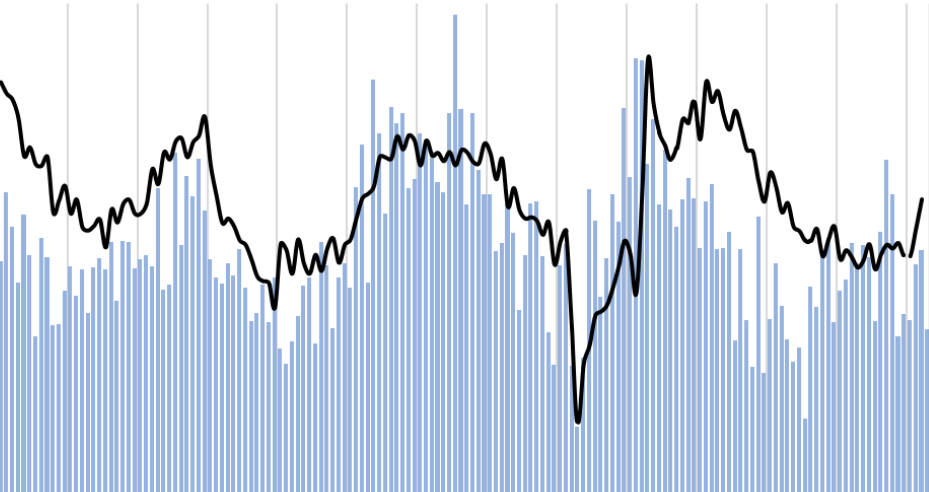
The April Fastener Distributor Index fell to 46.9 from March’s strong 52.6 reading, which “may have been artificially boosted by some buying ahead of tariffs by customers,” according to R.W. Baird analyst David Manthey (CFA) with Quinn Fredrickson (CFA).
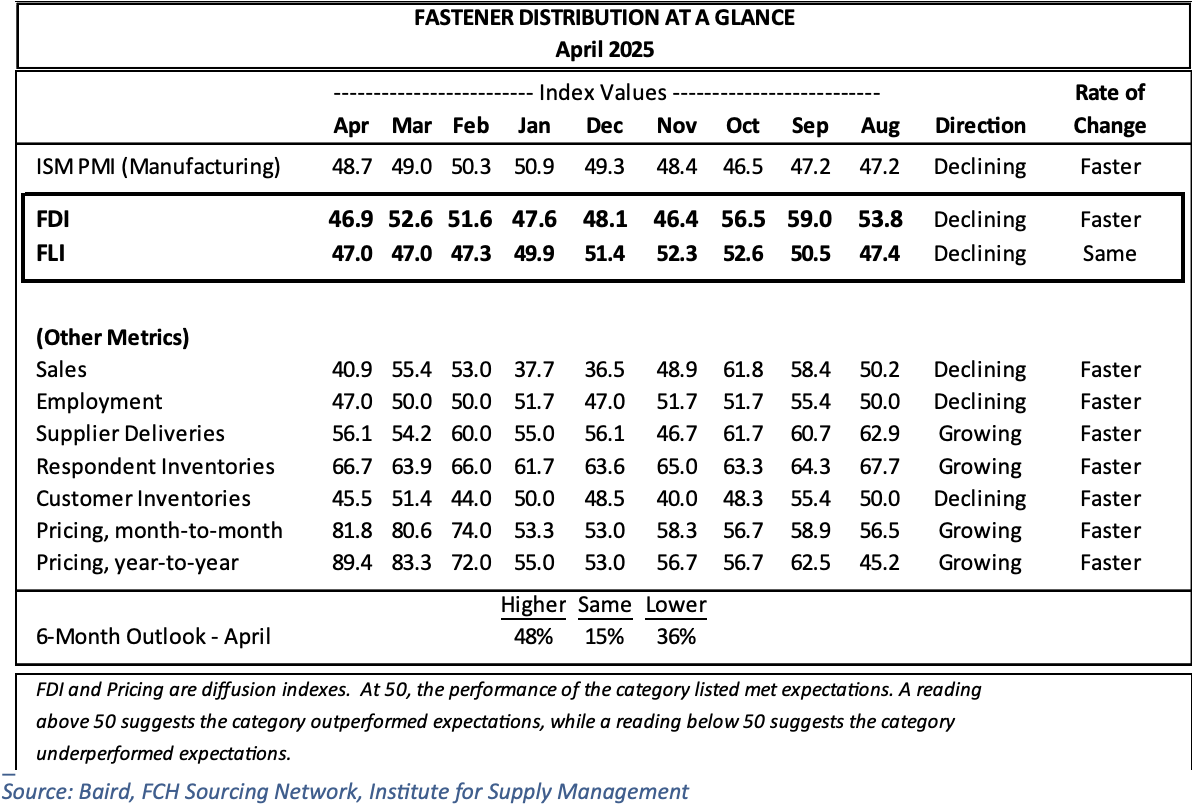
Only three in 10 respondents reported sales came in above seasonal expectations, down from 50% in March, while 45% indicated sales were below expectations (up vs. 25%) and another 24% indicated normal sales.
Employment was also slightly weaker on the margin, though largely steady with recent results, as 70% of respondents said April employment levels were similar to March.
“Pricing, meanwhile, continues to move sharply higher as steel/China/global import tariffs take hold,” wrote Manthey. A majority (64%) of respondents reported higher pricing, which follows 61% in March, 48% in February and just 17% in January. This drove the FDI Pricing Index to again set a record high since March 2022.
The Forward Looking Index steadied at 47.
“Respondent commentary points to potential recession ahead, fewer RFQ’s from customers, curbing demand for export customers, and general uncertainty/chaos in customer orders and planning.” A few comments were more positive – indicating robust backlog and strong sales growth – though these were more in the minority.
Quantitatively, the six-month outlook was also similar vs. March; 48% of participants forecast better activity levels over the next six months – slightly better vs. 44% last month but still significantly lower compared to December, when optimism drove 61% to forecast improvement. Another 15% see similar trends continuing (down vs. 22% in March and 24% in February), while 36% forecast sales deteriorating (vs. 33% last month).
Tariffs continued to dominate respondent commentary in April.
“Not surprising given their dominance over the news and market headlines, tariffs were the overwhelming area of focus for respondents’ commentary again.”
While industry participants may have been able to dodge the impacts for a month or two, tariffed inventory is now hitting the market.
“Tariff enhanced product starting to reach our inventory and we are preparing costing for pricing adjustments.”
Pre-buying ahead of tariffs likely explains why the FDI was strong in March, though this factor seemingly faded away in April.
“The tariffs resulted in a brief surge and then WHAM, it all just stopped. None of our customers know what to do. Some companies are taking advantage of their customers by raising prices far in excess of their tariff cost change (I'm looking at you **** and ****). Tariffs remain a horrible idea and only those who have never taken an economics class think they're a good idea (or those who haven't bothered to study history.)”
The great unknown is the impact on the broader economy ahead, particularly if so-called “reciprocal tariffs” are enacted following the current pause.
“Tariffs are wreaking havoc on the supply chain, our customer base, and it’s feared that higher prices will drive demand down and cause a recession. We are certain about uncertainty at this point.”
Customers who export products are likely to be severely impacted.
“Tariffs will initially boost top lines but that revenue will essentially be empty calories as our default approach is to pass them through rather than try and margin them. Longer term, we believe that second order inflationary effects of the tariffs are going to curb demand, especially for OEM customers for whom exports are a part of the revenue mix. We are already seeing clear, early evidence of this.”
Still, a few participants saw healthy business activity.
“We have a pretty robust backlog and all signs point to increased activity in Q3 and Q4. The wildcard is how resilient the economy will be given the uncertainty we're currently experiencing. Hard to know what it will look like 6 months from now when every day volatility is so sharp.”
The FDI is a monthly survey of North American fastener distributors conducted by the FCH Sourcing Network, the National Fastener Distributors Association and Baird.