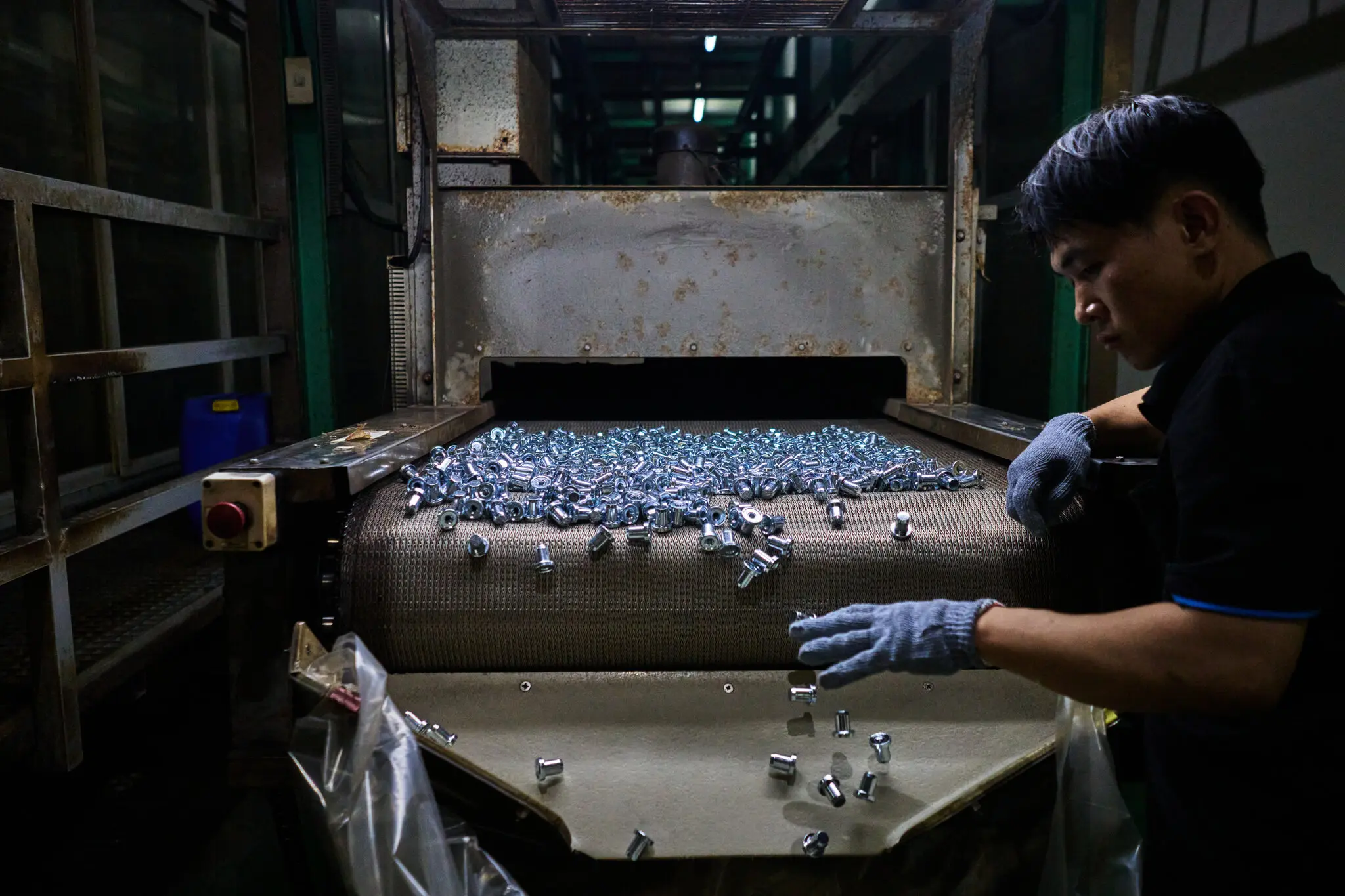
President Trump’s 50% tariffs on steel and aluminum have left Taiwanese screw makers wondering how their businesses will survive the next few months, the New York Times reports.
For more than three decades, Taiwan has been the top source of screws and metal fasteners like nuts and bolts to the U.S., with China gaining ground as the second largest.
At least 33% of U.S. fastener imports totaling $2.2 billion came from Taiwan in 2024, according to the U.S. Department of Commerce.
Since the steel tariffs took effect in June, Sheh Fung Screws Company’s orders have been down nearly 20% compared with the same time last year.
“Everything is in pause mode,” stated Kent Chen, whose grandfather founded in the company in 1973. “A lot of our customers said, ‘We’ll see,’ but then we didn’t receive many orders.”
When Chen, 48, took over the management of Sheh Fung in 2010, he invested in new equipment and systems to appeal to foreign customers, causing his business to boom. Until now.
In addition to Trump’s tariffs, a problem for exporters like Sheh Fung is the surge in Taiwan’s currency, which has appreciated sharply against the U.S. dollar this year.
“We never take losses,” Chen said. “But this year, in the second quarter, we really took quite a big loss because of the currency situation.”
Any move by the government to moderate the currency’s rise could draw the ire of the Trump administration. Taiwan is one of nine major trading partners the U.S. Treasury Department is monitoring for potential currency manipulation.
The Taiwan fastener industry also faces intense pressure from Chinese manufacturers, the NYT reports.
Chinese companies often quote prices 30% to 50% lower than Taiwanese screw makers, said Karl Tsai, 61, the general manager of Lu Chu Shin Yee and son of the company’s founder.
“The biggest advantage of Taiwanese suppliers lies in their high quality and precision,” LindFast Solutions Group CEO Mike Spencer recently remarked. “Our customers who require extremely low tolerance products can always rely on Taiwan suppliers to meet their needs.”
While pressure from Chinese competitors is not new, the combination of Trump’s tariffs and the currency appreciation has forced the industry to a tipping point.
About a dozen factories in Kaohsiung have closed since the currency began appreciating and the tariffs took effect, according to local legislator Chiu Chih-Wei.
Some big companies like Lu Chu Shin Yee and Sheh Fung have factories in China, the Philippines and Vietnam, where they can move production to help lower costs. But smaller manufacturers don’t have that flexibility.